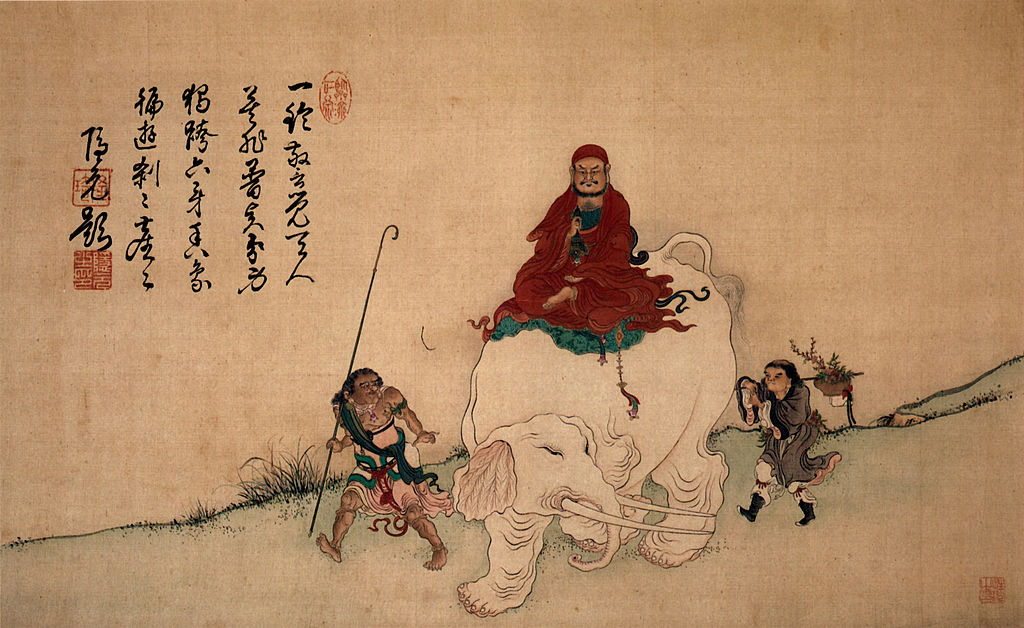

To enter the Great Way there are many paths, but essentially they are of two means: by Principle and by Practice.
Entering the Way by Principle means to awaken to the Truth through the doctrine, with a deep faith that all sentient beings have the same true nature. Obscured by the fleeting dust of delusions, this nature cannot manifest itself. If one can relinquish the false and turn to the true, fix the mind in “wall meditation”, understand that there are neither self nor others, that mortals and saints are equal and one - abiding this way without wavering, clinging not even to the scriptures, then one is implicitly in accord with the Principle. Being non-discriminative, still, and wu-wei is to Enter by Principle.
Entering by Practice means following four practices that encompass all other practices. They are: accepting adversity, adapting to conditions, seeking nothing, and acting in accordance with the Dharma.
What is the practice of accepting adversity? When suffering, a practitioner of the Way should reflect: “For innumerable kalpas, I have pursued the trivial instead of the essential, drifted through all spheres of existence, created much animosity and hatred, maligned and harmed others endlessly. Even though now I have done no wrong, I am reaping the karmic consequences of past transgressions. It is something that neither gods nor men can foresee or impose upon me. Therefore I should accept it willingly, without any resentment or objection.” The sutra says, “Face hardships without distress.” How? With thorough insight. With this understanding in mind, you are in accord with the Principle, advancing on the path through the experience of adversity. This is called the practice of accepting adversity.
Second is the practice of adapting to conditions. Sentient beings are without a self, being steered by karmic conditions. Suffering and joy are experienced together as a result of cause and conditions. Any reward, blessing or honor is a consequence of past causes, and is gone when the necessary conditions are exhausted. So what is there to be joyful about? Knowing that success and failure depend on conditions, the Mind neither gains nor loses, remaining unmoved by the winds of joy. This is to be in harmony with the Way. Therefore it is called the practice of adapting to conditions.
Third, to seek nothing. Ordinary people, in their perpetual ignorance, crave and form attachments to everything, everywhere. This is called seeking. The wise are awakened to the Truth, and choose reason over convention; their minds are at peace and wu-wei. All forms change with karma, all existence is empty, hence there is nothing to be desired. Blessing and Darkness always follow each other. This long sojourn in the Triple Realm is like living in a burning house; to have a body is to suffer, how can one attain peace? Those who understand this renounce all mundane existence, cease desires, and stop seeking. The sutra says, “To seek is to suffer, to seek nothing is bliss.” It follows that to seek nothing is to truly follow the Way. This is the practice of seeking nothing.
Fourth, to act in accordance with the Dharma. The principle of intrinsic purity is the Dharma. By this principle, all forms and characteristics are empty, without defilement and attachment, without self or others. The sutra says, “In the Dharma there are no sentient beings, because it is free of the impurities of sentient beings. In the Dharma there is no self, because it is free of the impurities of self.” When the wise believe in and understand this Principle, they should act in accordance with the Dharma. There is no stinginess in the Dharma, so practice the giving of body, life, and possessions, with a mind free of parsimony. Understand and achieve “triple emptiness”, with no reliance and no attachment. Practicing for the sake of removing impurities, one liberates others without becoming attached to form. This benefits oneself, benefits others, and also glorifies the bodhi path. This is the perfection of dana; it is likewise with the other five paramitas. In order to relinquish delusions, one practices these six perfections, yet there is nothing that is practiced. This is to act in accordance with the Dharma.
***
Mahayana: The “Great Vehicle,” one of the two traditions of Buddhism (the other is Theravada), it emphasizes the path to Buddhahood, perfection of wisdom and unconditional compassion.
Bodhidharma: The 28th Patriarch of Zen from India, who came and founded the Zen school of Buddhism in China (and therefore is the first Zen Patriarch of China). This current text is one of the very few records we have of his teaching.
Enter the Great Way: “Great Way” refers to the Mahayana path, the path to become a Buddha and enlighten countless others. To enter the Great Way is to truly understand what it means to become a Buddha.
Two means: Even though many methods of Buddhist practice are possible, they all employ one of two means: either by gaining a direct understanding of the highest Truth (“by Principle”), or by using various practices that lead up to the final understanding of the highest Truth (“by practice”). Sometimes the two means are combined.
By Principle: This is the quintessential Zen practice, the “gateless gate”, the method of “directly seeing one’s nature and becoming a Buddha.”
Doctrine: Here it refers to the canon of Buddhist teaching: the Dharma; the scriptures and their commentaries; the philosophy.
Deep faith: Faith based on correct understanding of the Dharma, faith based on unbiased reasoning and experiences, as opposed to faith based on superstitions or unfounded beliefs.
Sentient beings: All living beings with sentience, that is, living beings that can feel, are aware, have consciousness. All sentient beings (including animals and other beings invisible to the human eye, but excluding plants, rocks, water, etc.) can become Buddhas.
Same true nature: Though the appearances of sentient beings are different, due to their past karma, their sentience, which is variously referred to as “mind,” “consciousness,” “awareness,” or “Buddha nature,” is fundamentally equal in nature. To be enlightened is to personally experience this fact.
Fleeting dust of delusions: The original mind is like a mirror covered with the dust of delusions; therefore its reflections (of reality) are unclear and distorted. What we take as our “body and mind”—form, feeling, conception, volition, and consciousness are the fleeting dust, impermanent, defiling, obscuring our true nature. Ignorance, greed, anger, pride, jealousy, and other vexations are also “fleeting dust of delusions.”
Wall meditation: “Wall” represents firmness, resolve, immovability, stability. “Fix the mind in wall meditation” means to practice meditation so that the mind is unaffected by all afflictions and distractions, so that it can gain the clear vision to penetrate delusions.
Neither self nor others: The separation or boundaries between oneself and others (or the external world) is illusive.
Mortals and saints: Mortals are ordinary beings, subject to rebirth in samsara (world with suffering). Saints are arhats, bodhisattvas and Buddhas who have attained liberation, are pure in mind and actions and are deathless.
Abiding this way: To be mindful of this Principle without being affected by doubt or vexations.
Cling not to scriptures: The scriptures are important as guidance to enlightenment, but there is always a danger of interpreting them too literally, of misinterpretation, or of studying them as philosophy without practicing the teaching. None of the above will lead to true understanding.
Implicitly in accord: Even though one may not fully understand the Principle yet, by always keeping this teaching in mind and acting accordingly, one is in harmony with the Way, leading to enlightenment.
Non-discriminative: Do not discriminate with bias or distortion.
Still: Stillness means free from disturbances. An unenlightened mind is constantly disturbed by greed, anger, selfish interests, etc. A mind of absolute stillness is nirvana.
Wu-wei: Free from forced effort (but not necessarily no-action), free from clinging and attachments, unconditioned, absolute. It also means inner peace obtained by having no desires, with the understanding that we are intrinsically complete and lacking nothing.
Four practices: All other, more “tangible” Buddhist practices, are in essence one of the following, or a combination of the following, four practices.
Reflect: When something unpleasant happens, we should try to be calm and remember the Dharma teaching instead of reacting with imprudence.
Kalpa: A kalpa is a very long period of time. Formally, a large kalpa is a cycle of the universe, which consists of four stages: birth (of the universe or a “Buddha-land”), stability, disintegration, and void. The universe is then recreated (and destroyed), over and over again, by our collective karma. Innumerable kalpas: for all these countless lifetimes in the past.
Trivial/essential: Without knowing the true nature of life and the “self,” people go on endless pursuit of things that are ultimately of no consequence. What is most meaningful in your life? Are you working on it or pursuing trivial matters?
Spheres of existence: A sentient being can take rebirth in any one of the six spheres/planes of existence in the Triple Realm: as a deva (a celestial being), an asura (powerful like a deva but more aggressive and jealous), a human being, an animal, a hungry ghost, or a being in hell, all depending on one’s karma (actions, deeds).
Animosity … harm: Due to our ignorance of the Way, we have intentionally or unintentionally created much harm to others in every lifetime, not to mention countless lifetimes! By the Principle of Causality, we really have no grounds to feel resentment for the suffering we are currently facing.
Karmic consequence: Karma means action. Actions have corresponding consequences. Actions that benefit others bring blessings and happiness, actions that harm others bring suffering. One is subject to the consequences of one’s own karma.
Transgression: An act against the natural law; an act that harms others.
Gods: In Buddhism there is no creator God, but there are devas or celestial beings who are born with more powers and blessings than human beings due to superior deeds in their past. Some can see into one’s past or future. However, one’s fate is determined by one’s own karma.
Thorough insight: One can face hardships without distress if one fully understands Causality and the teaching already mentioned above. People resent their fate because they do not have this insight. With the insight of “accepting adversity,” one can turn suffering into spiritual progress.
Adapting to conditions: All things arise from appropriate sets of causes and conditions, and will cease to exist when the conditions fall apart. This is the teaching of conditional arising, also called dependent origination. The enlightened and the wise understand and adapt to conditions, whereas the ignorant and foolish try to get results without the appropriate conditions, or are unaware of the changing conditions, thereby bringing misery and disappointment.
Without a self: The “self” refers to an intrinsic, independent identity which we perceive in beings and things. In a person, it is the false self or ego or “inner identity” that one takes for granted; in objects, it is the intrinsic value or character we associate with it. This “self” is a delusion because it is dependent on changing conditions.
Suffering and joy: Suffering is a result of harmful actions (karma), and joy is a result of beneficial actions. Most people experience a mixture of suffering and joy in their lives because they have created both good and bad karma in the past (the causes and conditions).
Reward/blessing/honor: Result of good karma. Even though they are favored over suffering, they are also impermanent. To not realize this can lead to suffering.
Neither gains nor loses: In practice, the mind is in equanimity, neither elated nor depressed. In principle, nothing is gained and nothing is lost.
Attachments: To crave or desire anything, to cling to or despise anything, to dwell in the past or grumble about the present are all examples of attachment.
Reason over convention: Many common beliefs and practices are actually unwise, senseless, or even dangerous. Sometimes the truth is the opposite of what we believe. The wise can see what is real even if it means going against “conventional wisdom.”
All forms: All forms and appearances, all phenomena are driven by karma.
All existence is empty: Because all existence is dependent on conditions, there is no intrinsic, independent identity or “self.” The perceived qualities of objects or phenomena, whether desirable or undesirable, are conditional, relative, and impermanent, hence nothing is ultimately desirable. Blessing and Darkness: The Maha-Pari-nirvana Sutra tells of the story of a pair of deva sisters named
Blessing and Darkness; wherever Blessing goes, good fortune follows; wherever Darkness goes, misfortune follows. However, the two sisters are inseparable, one cannot receive one sister without the other.
Triple Realm: (1) The Realm of Desire (kama-dhatu), where beings of the six spheres reside. They possess physical forms and have varying degrees of desires for wealth, lust, fame, food, and sleep. (2) The Realm of Form (rupa-dhatu), attainable only by beings who have reached one of the four dhyana stages (deep mental concentration states achieved with meditation). They have finer, uni-gender physical forms but not the desires of the lower realm. (3) Formless Realm (arupa-dhatu), by more refined meditation, they are able to eliminate physical forms and exist in various extremely subtle consciousness states only. The two upper realms have only devas. All beings of the Triple Realm, regardless of their power of meditation, are still subject to karma and rebirth and therefore have not attained liberation.
Sojourn: In our endless rebirths, we have taken on all different forms of being and traveled through all of the Triple Realm. Without enlightenment, it is a journey without end or ultimate purpose.
Burning house: Each life in the Triple Realm will eventually end in death, so the world we live in is like a burning house that will turn into ashes sooner or later. Those who do not realize this are still busily stuffing things into this house, instead of thinking of ways to get out!
Body is suffering: Birth, aging, illness, and death are all afflictions of the body that are unavoidable as long as one has a physical body.
Mundane existence: The six spheres of existence in the Triple Realm.
Stop seeking: Seeking is defined here as the attachment to things and phenomena, to gratify the selfish ego. When one understands the underlying empty nature of these things, one can have true peace of mind and stop seeking. However, we can, out of compassion, seek to enlighten and benefit others without attachment to the ego.
Act in accordance with the Dharma: Finally, this practice of six perfections (paramita) brings one’s action and mind back to the single, ultimate Principle.
Intrinsic purity: All dharmas (lowercase dharma means all phenomena) are neither good nor bad, beyond dualistic discrimination. Therefore it is called “intrinsic purity;” this purity is absolute, like the empty space, which can neither be contaminated nor cleansed.
Forms and characteristics: The Chinese word xiang means forms, marks, or appearances; it is extended to mean all perceived characteristics of any phenomena.
Impurities of sentient beings and self: Ordinary sentient beings have the deep-rooted delusion of an intrinsic self, which develops into the ego and subsequently gives rise to greed, anger, ignorance, pride, and a host of false views; they then lead to the suffering of sentient beings. Being delusions, these false views and vexations have no real substance. Therefore, all dharmas are intrinsically “free from all impurities.” To act with this understanding of no-self is to act in accordance with the Dharma.
Dana: The practice of charity, which involves giving of possessions, body, Dharma, encouragement, etc. One is not able to give freely because of the attachment to the self. Without the selfish ego (“impurities of the self”), one can give anything others need, which benefits others as well as the self.
Triple emptiness: The highest form of dana is to give without the concept of the giver, the receiver, and the given, because all are empty. Then one can truly give without expectations, without the ego being involved. This is the perfection of dana, or dana paramita.
Six paramitas: Dana, sila (moral conduct, precepts), ksanti (tolerance, patience), virya (diligence, effort, persistence), dhyana (meditation), and prajña (wisdom) are the six perfections, the Mahayana path to Buddhahood. The practice of the six paramitas can remove our impurities/delusions, which are originally empty, so in the end, nothing is gained and nothing is lost. Still, one then becomes a Buddha; without the practice, the Buddha nature is latent and one is an ordinary sentient being imbued with suffering.
Glorifies the bodhi path: bodhi is “awakening.” To glorify the bodhi path (path to Buddhahood) means the Mahayana ideal of bringing countless beings to enlightenment along with one’s own enlightenment.
Read more texts
- Log in to post comments